
Cart is empty


Correct thickness of artificial nail: cuticle, apex and free edge
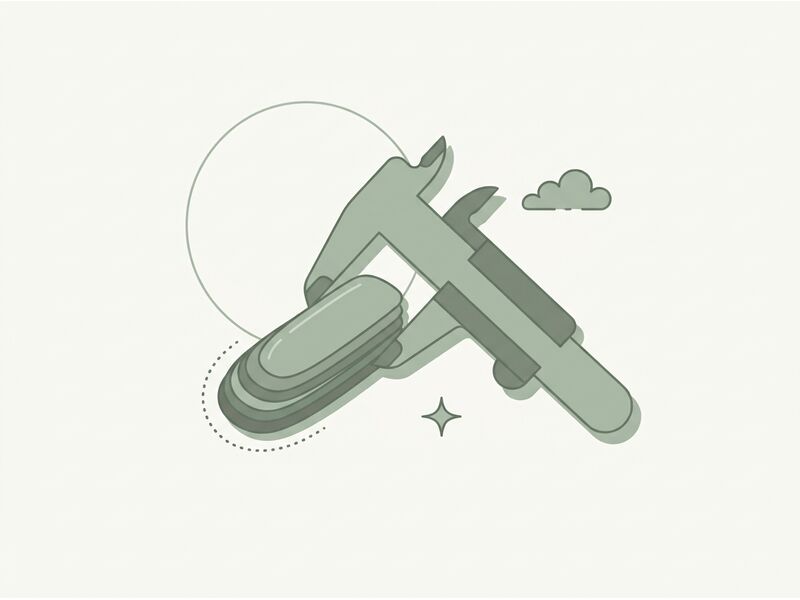
An artificial nail should not have the same thickness from cuticle to tip. The material is distributed according to load: a thin smooth transition in the proximal zone, sufficient structure in the stress zone, and a controlled free edge. A universal number in millimeters without considering length, shape, and material is misleading.
Thickness is a map, not a number
The same volume of material along the entire length creates a heavy and at the same time unbalanced construction. Proper architecture is determined by three views:
- from the side — apex position and lower line;
- from above — central axis and side parallels;
- from the end — transverse arch, symmetry, and free edge thickness.
Assessment only from above hides dips, excessive apex, and a heavy tip.
Construction zones
Proximal zone
The transition near the cuticle should be thin and smooth, without a ledge and contact with the skin. A thick step becomes noticeable as it grows out, provokes snagging, and complicates correction.
A thin transition does not mean aggressive filing of the natural plate. The shape is created by precise application and controlled filing of the artificial material.
Stress zone and apex
In the area of greatest load, a structural reserve is needed. Its position depends on length, shape, and the free edge growth point. The apex is not a random "drop in the middle" and should not look like a bump.
Free edge
The tip should be sufficient for the selected material and length, but without excess mass. An overly thin tip chips, an overly thick one creates a heavy look and shifts the balance forward.
What the distribution depends on
| Factor | How it changes construction |
|---|---|
| Length | longer lever needs more precise support in the stress zone |
| Shape | square, oval, almond, and stiletto have different side lines and tip |
| Material | elastic base, hard gel, and acrylic behave differently |
| Natural nail | growth direction and width affect axis correction |
| Wear style | daily and professional load change risks |
Thickness does not compensate for excessive length or incorrect material. If the construction does not suit the plate, it is better to change the length or system.
Typical mistakes
"Credit card" as a universal standard
Comparison to a card can be a visual metaphor for the tip, but not a technical standard for the entire construction. It does not consider length, shape, and material properties.
Too large apex
More material does not always mean stronger. Excessive volume adds weight, complicates polymerization, and requires extra filing.
Flat construction
Uniform thin thickness without stress zone support may flex or break at the transition from nail bed to free edge.
Heavy free edge
Material accumulates at the tip due to incorrect form placement, too large a drop, or lack of control from below.
Filing only the top surface
The master removes the apex but does not check the lower line and side surfaces. As a result, the construction becomes flat on top and thick on the bottom.
Control after sculpting
- Check the central axis from above.
- Assess the apex and lower line from the side.
- Look at symmetry and the tip from the end of the nail.
- Turn the hand over, if the technique allows, and assess distribution before cure.
- After filing, repeat all three angles.
- Ensure there is no material contact with the skin.
For structure, choose gels or acrylic by properties, and refine the shape with controlled nail files, without filing away the needed stress zone.
Products from the article
Frequently Asked Questions
Скільки міліметрів має бути в апексі?
Без довжини, форми, матеріалу та схеми виробника універсальної цифри немає. Орієнтуйтеся на пропорції й структурні вимоги конкретної системи.
Чи можна зробити довгі нігті дуже тонкими?
Візуальна тонкість досягається правильними лініями, а не відсутністю структури. Довший важіль потребує матеріалу у відповідних зонах.
Чому ніготь ламається біля вільного краю?
Причинами можуть бути тонка stress zone, неправильне положення апекса, надмірна довжина, боковий перепил або матеріал, що не відповідає задачі.